By Lee Leigh (“Lili”)
As the calendar turns to 2026, you stand at the threshold of opportunity. This year can be the one where you transform your study routines to sharpen your skills and step confidently towards certification. Students often wish for a magic potion for success because the discipline necessary to get to 225 wpm can wear you down. But the answer isn’t magic or discipline — it’s neuroscience. Your brain is wired to form habits, and when you understand how those habits work, you can harness them to accelerate your progress in court reporting (and life!).
When NCRA’s Student/Teacher Committee began brainstorming article ideas for students, I immediately knew I wanted to tackle this topic because it’s deeply personal to me. I’m not here to recycle trendy advice or hype up a “new year, new me” mindset. I want to genuinely share how building habits transformed my health and happiness, and why I believe they can do the same for you.
My habit journey began in 2019 when I hit my lowest point and decided to walk away from a dream that I’d poured myself into — creating safe spaces for my community. I loved managing dance clubs and restaurants, but the reality was brutal. After years of 80‑hour weeks I was burned out, running on fumes, and stuck in a cycle of habits that were dragging me down. What started as a passion project had morphed into something that drained me completely. To cope I was smoking constantly, binge drinking, living off restaurant food, and had zero time or energy for movement or mindfulness. I reached a point where I had to relearn how to function: how to take care of myself, rebuild routines, and create a life that didn’t hollow me out.
Today I can honestly say that I’m taking care of myself in ways I never used to. I’m working with my doctors to address my health issues, I returned to my court reporting career and am thriving, and I’ve even made space to volunteer for NCRA again. I quit smoking more than five years ago, I’m more than 200 days sober, I bike‑commute and work out consistently, and I’ve built daily practices like meditation, gratitude journaling, and using my planner and habit trackers religiously.
That doesn’t mean the process has been flawless. I still stumble, and I’ve learned that setbacks, whether in life or in school, aren’t signs of failure. No one nails consistency perfectly. Life is messy, routines get disrupted, and staying on track takes real effort. The good news is that the science of motivation and habit formation gives us tools to understand those struggles and keep moving forward.
Court reporting is a demanding profession that requires precision, speed, and unwavering focus. For those of you preparing to enter this field, success often hinges not just on technical skills but on the daily routines and behaviors that shape your learning. This is where the science of habits becomes a game-changer.
Every steno student knows how tough it can be to stay motivated, but repetition is the backbone of court reporting training, which is why you spend countless hours on the machine. Muscle memory and habits both rely on automation, but they’re not the same thing. Muscle memory is the brain’s way of streamlining complex physical movements like writing steno. Habits, on the other hand, are broader, automatic routines — like grabbing coffee at the same time every day — that can involve actions, thoughts, or sequences of both.
In simple terms, muscle memory teaches you how to perform a physical skill, while habits shape when and why you do certain things. Both depend on repetition to shift tasks from conscious effort to subconscious efficiency, tapping into the brain’s natural drive to automate anything it can.
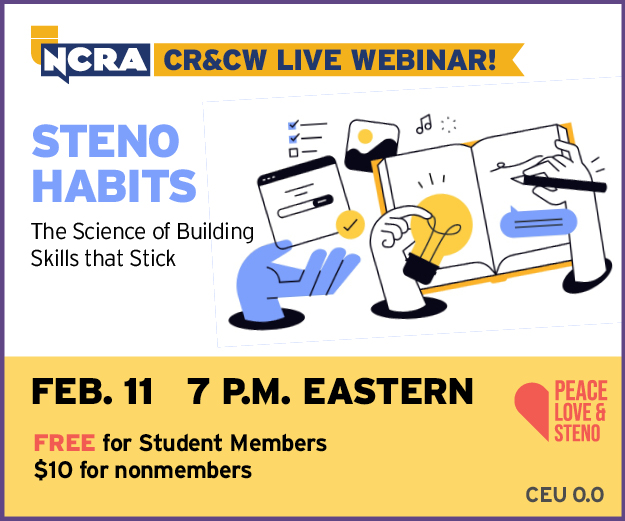
Below I outline the general science behind habits and offer some tips on how to create and break habits. Mark your calendar for Wednesday, Feb. 11, at 7 p.m. Eastern, for a live NCRA webinar, “Steno Habits: The Science of Building Skills that Stick,” that will dive deeper into this topic. Some amazing reporters, Chris DeGrazio; Rich Germosen, FAPR, RDR, CRR; Deneé Vadell, RPR; Alecia Madison, and myself, will share our insight and experiences as we support your growth.
Habits are automatic behaviors that kick in when certain cues appear in our environment. Neuroscience shows that these patterns are stored in the basal ganglia, the part of the brain that handles routines and recognizes repeated patterns. Once a habit is established, it takes far less mental effort to carry out, which frees up your brain for more demanding tasks.
For court reporting students, this is powerful. With consistent practice, what once felt exhausting can start to feel natural. The more you build strong, productive habits, the less you’ll find yourself battling inspiration or willpower. Your routines begin doing the heavy lifting for you.
Habit Loops: Every habit follows a loop: cue → routine → reward.
When you sit down at your machine at the same time each day (cue), practice dictation (routine), and celebrate with a small treat (reward), your brain strengthens the loop. Over time, practice becomes automatic.
Neuroplasticity: Your brain is constantly rewiring itself. Each repetition of shorthand strokes builds stronger neural pathways, making speed and accuracy easier.
Chemicals of Motivation: Dopamine spikes when you celebrate small wins, serotonin rises when you feel proud of progress, and oxytocin grows when you connect with peers. These chemicals keep you motivated and resilient.
Subconscious Influence: Negative self‑talk can sabotage progress. Neuroscience shows that affirmations and gratitude journaling literally rewire the brain toward confidence and optimism. Also, when your habits align with your self‑image, your brain reinforces them more powerfully. For example, telling yourself “I’m a court reporter” activates motivational pathways that go beyond the basic habit loop and strengthens the behaviors that support that identity.
Recent frameworks, such as James Clear’s “Atomic Habits,” expand the loop to four stages: cue, craving, response, and reward. The craving, the anticipation of the reward, explains why certain behaviors feel irresistible and why habits persist even when the reward diminishes. Over time, the brain associates the cue with the expected reward, creating a craving that drives the routine. Dopamine plays a critical role in this process, reinforcing the connection between cue and action and locking the loop in place.
Dopamine is a neurotransmitter central to motivation, pleasure, and reinforcement learning. This anticipatory dopamine surge strengthens neural pathways encoding behaviors as habits. I’m almost embarrassed to share how much joy I get from checking off something on my habit tracker. It feels like giving myself a like 👍for showing up and becoming a better version of me.
Based on my own habit‑building experience and my years as a court reporting educator, here are the most powerful habits to focus on in 2026:
- Consistent daily practice — shorthand drills and dictation
- Sleep hygiene — consistent bedtime, no screens before bed
- Structured morning routine — start with planning or a short drill
- Mindfulness and stress management — breathing, meditation, or reflection
- Goal tracking — log words per minute and accuracy daily
- Healthy eating and hydration — fuel your brain for long practice sessions
- Gratitude and affirmations — fight self‑doubt and build resilience
- Breaks and rewards — short celebrations to reinforce progress
- Continuous learning — expand vocabulary and sharpen transcription
- Positive social connections — study groups and accountability partners
Think of every practice session as a vote for the person you’re becoming. Each drill is not just a task — it’s a brick in the foundation of your career. Each affirmation is a reminder that you are capable. Each reward is fuel for your brain’s motivation system.
2026 can be the year you stop seeing yourself as “just a student” and start living as a “professional in training.” Habits are the bridge between where you are and where you want to be. Step onto that bridge today, and by the end of the year, you’ll be amazed at how far you’ve come. Just keep showing up, and the results will follow.
Lee Leigh (“Lili,” she/they), RPR, CRI, is an official from Madison, Wis. She can be reached at mxcourtreporter@gmail.com.