An interview with U.S. Supreme Court Justice Ketanji Brown Jackson
By Nancy J. Meyer
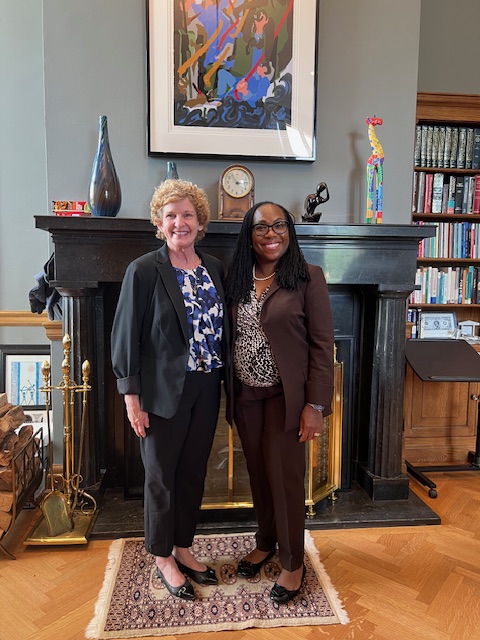
I had the opportunity to have a Zoom interview with Justice Ketanji Brown Jackson about the role of court reporters within the judicial system. Below is our interview.
Nancy J. Meyers | First off, Justice Jackson, thank you for taking the time to have a Zoom interview with me, especially when I know that your new term is starting next week. What inspired you to choose the legal profession?
Justice Ketanji Brown Jackson | I think probably my experience growing up in a household in which my father had gone back to law school. When I was born, my parents were public school teachers in Washington, D.C., and my father was a history teacher, and I think he got motivated because he was here in our nation’s capital taking his high school students to the various institutions here in D.C. and really getting interested in thinking about the law.
And so he decided to go back to law school when I was three years old, and we moved down to the University of Miami, which is where he got in and where my parents were from originally. And some of my earliest memories are of being there on the campus, my dad in the kitchen in the apartment that we had on campus; and my father had his law books and I my coloring books, and we were working together. And that, I think, is what made me think that you really couldn’t do anything else but be a lawyer. That’s just what I’ve always known and thought about.
NJM | What motivated you to consider a role in the judiciary?
KBJ | Well, I think it was learning about Judge Constance Baker Motley, who was the first African American female judge to be appointed to the federal bench, and she was actually appointed a little while before I was born. She was appointed in the 1960s. I was born in 1970.
And I learned about her in middle school and remember very clearly being intrigued by her, in part, because we had the same birthday. And I had wanted to be a lawyer because my dad was a lawyer, but learning about the fact that there was this Black woman who was a judge, I thought, “Well, maybe that’s something that I could do too.”
And I also learned about — around the same time about Justice O’Connor on the Supreme Court, and it was just an eye-opening experience that lawyers can become judges, and women could actually be judges and justices at the height of the profession.
NJM | How did you first become aware of the role of a court reporter?
KBJ | I think my first real connection with court reporters and my first understanding of what they did happened when I was a District Court law clerk, which was the year after I graduated from law school.
So in 1996, I clerked for a judge in the District of Massachusetts, Judge Patti Saris. And she had quite a few trials and other hearings in court and had a wonderful court reporter, and I just remember the significance of the transcripts and how she used them and how she relied on them and the relationship she had with her long-time court reporter and how important the court reporter was to the work of the District Court.
But that was my first real insight into the significance of a court reporter to a district judge.
NJM | What qualities do you most value in a court reporter?
KBJ | Well, I think that attentiveness is very important; someone who is able to be professional in the way in which they approach the judge, the parties, and the court staff. Obviously, one who’s good at their job, who is not constantly requiring people to repeat things or, you know, asking for things to be redone.
And the court reporter is a part of the team supporting the judge, and so good interpersonal skills, I think, are really important, and to have someone who can be a successful member of the staff in supporting the work of a judge.
NJM | You advocated for the use of realtime while serving on the District Court bench. In what ways did you incorporate realtime into your courtroom proceedings?
KBJ | Well, realtime was really a significant advancement. I think I started without it, and it came during my time to our court, and I almost can’t remember doing the job without it.
Because what it allowed was for during trials when objections were being made, during hearings when objections were being made, I could quickly go back and review the form of the question. I could go back and understand how the evidence had come in that led to that particular objection that I needed to rule on.
It helped me to keep track during arguments – when we weren’t doing a trial, when the parties were appearing for argument, sometimes the legal issues can be very complex and people can meander in their answers. And so I would use it often to scroll back and say, “Well, I’d like to go back to this point that you made,” and the transcript in realtime allowed me to do that.
And I would take recesses sometimes in proceedings when I had to make complicated evidentiary calls and go back and review the transcript that had come in in realtime, which is much harder to do if you’re not getting, sort of, a live feed.
But I think it really made it so much easier to do oral arguments when you were able to refresh quickly on what had previously been argued and go back to a point or correct a lawyer who, you know, the more you correct them, then they say, “Well, we didn’t say that.” And then I would go back and say, “But, yes, you did” and quote, you know. I’d be able to quote back what they had said. So that really prevented people from departing from the arguments that they had made that I found interesting.
So I just — I really found it to be invaluable in terms of my practice as a District Court judge.
NJM | At the Circuit level, you relied on trial transcripts to prepare for appellate hearings. What qualities did you find most important in those transcripts? Did you read the transcripts, or did you have your law clerks read the transcripts?
KBJ | When I was on the Circuit bench as a judge, my law clerks probably did more original research like that.
But I was also a Court of Appeals law clerk. So when I clerked for a Court of Appeals judge, I was the one who was reading the transcripts and advising him and checking what the parties had said in their briefs about the lower court’s proceedings.
I was also an appellate lawyer. When I was a public defender, I was an appellate defender, and so I read hundreds of trial transcripts because I was trying to develop arguments to make — to bring arguments to the Court of Appeals related to potential errors at trial. So I’m very familiar with reading and reviewing trial transcripts.
And, obviously, you know, you want the transcript to be clear about who is speaking. I think that’s very important; legibility in terms of complete sentences. You know, sometimes people don’t talk the way that English is written, and I’m sure it can be difficult at times for a court reporter to put in the right kind of punctuation and have the sentences set up in the way that they were intended, and legibility is very important.
And it’s my understanding that court reporters review what they have done in order to make sure that the sentences all make sense and the paragraph spaces are where they should be based on how the information was presented. And so having all of that laid out is important.
And, of course, you know, no misspellings. You try not to have a lot of distractions. Those things are distracting if there are mistakes in the transcripts. So those are the things that I looked for, but relied very, very heavily in my practice and in my work as a law clerk on reading transcripts.
NJM | Now that you’re serving on the Supreme Court, is realtime provided during oral arguments? And how does the Supreme Court make use of a court reporter in its proceedings?
KBJ | Well, much to my dismay, realtime is not provided. We do not get the transcripts at our places there when we are up on the bench. And it makes it a lot harder. You have to really focus and pay attention, and I try to take notes in a way that I think I wouldn’t need to as much if I had the realtime readout.
I understand there is a court reporter involved, but I don’t, frankly, remember being introduced or talking to this person. We have oral —I think our arguments are livestreamed and captured orally. And sometimes if a law clerk needs to immediately access them, they can do it that way.
I believe the transcripts are available later in the day after our oral arguments, but, again, my law clerks would be the ones to access those, not me. But it would be most useful for me to have a live-time transcript of the oral argument, but we do not, unfortunately, in our current practice.
NJM | I’m surprised you haven’t been able to implement realtime at the Supreme Court yet.
KBJ | (Laughter.) I know. I’m working my way up. Seniority. It would be great.
NJM | Stenographic court reporters are widely regarded as the gold standard for capturing the spoken word. What words of encouragement would you offer to court reporter students who will be reading this interview?
KBJ | Well, first, I would say congratulations because you are undertaking very important work that is valued and valuable for the court system and much appreciated.
And so, obviously, you want to do your best. You want to study hard. You want to ensure that you’re doing accurate work because that will make you very prized in the system. But every District judge, every trial judge I know relies very heavily on their court reporter, and you are getting skills that will make you sought after in the system. And so we appreciate you.
NJM | Do you have any words of wisdom for the court reporters who play a vital role in delivering justice by accurately capturing the spoken word each day?
KBJ | Well, I guess I would just give you the same words of wisdom that I provide to all court staff, which is just to say how important you are to the work of ensuring that justice is served in this country.
The courts have a very unique and important role to play, and ensuring that truth is being preserved is part of the work of the court reporter; that you are there witnessing what is actually occurring in the courtroom and ensuring that all who are interested in this proceeding have access to the truth of what happened.
And because truth is such a central part of what we do in the justice system, your work is vital, and you should persevere, to the extent possible, in ensuring that your essential duties are fulfilled.
NJM | Thanks again for your time today. I appreciated the opportunity to work with you and miss the calm, steady pace of your speech in court.
Nancy J. Meyer, RDR, CRR, has enjoyed a diverse career in court reporting that includes freelance work, State of Minnesota service, and now a federal court reporter position with the District of Minnesota where she reports for The Honorable Jeffrey M. Bryan. Previously, she served as a federal official reporter in the District of Columbia and was Justice Jackson’s court reporter from 2019 until Justice Jackson’s appointment to the D.C. Circuit Court in 2021. She can be reached at nancymeyercourtreporter@gmail.com.