NCRA Government Relations is proud to announce that U.S. Rep. Harriet Hageman from Wyoming and U.S. Sens. Roger Wicker from Mississippi and Peter Welch from Vermont have introduced the Research and Oversight of AI in Courts Act of 2026, bipartisan and bicameral legislation backed by the Association that would establish comprehensive oversight mechanisms for Artificial Intelligence (AI) and Automatic Speech Recognition (ASR) technologies used in judicial proceedings. Read the Senate Bill and the House Bill.
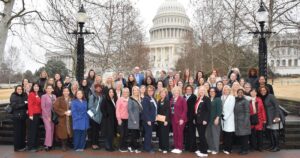
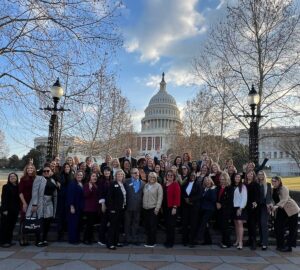
This comes just weeks after the 2026 NCRA Leadership & Legislative Boot Camp where NCRA Executive Director Dave Wenhold, CAE, PLC, and Colin Brehm, NCRA’s Director of Government Relations, led a three-day immersive training of more than 70 members to advocate for the bill during visits with lawmakers and their staff on Capitol Hill.
The bill comes as courts nationwide increasingly consider using AI-powered and automatic speech recognition transcription and recording systems, raising concerns about accuracy, security, and the preservation of due process rights. NCRA has been actively campaigning to inform the public about the impact of using these transcription technologies in the courtroom, with the theme “The Real AI: Accuracy & Integrity.”
“The integrity of our judicial system depends on accurate, secure, and reliable court records,” said NCRA President Cindy Isaacsen, RPR, an official court reporter from Shawnee, Kan. “As new technologies are integrated, we must ensure proper oversight and accountability measures are in place.”
NCRA, the leading organization representing court reporters, captioners, and legal videographers, has raised concerns about the reliability of AI-powered and automatic speech recognition court reporting systems. The Association argues that human court reporters remain essential for ensuring accuracy and maintaining the confidentiality of sensitive legal proceedings.
“Court reporters undergo extensive training and certification to provide the precise, secure transcription services our justice system requires,” said Dave Wenhold. “While technology continues to evolve, human expertise remains irreplaceable in capturing complex legal proceedings.”
The bipartisan and bicameral bill would also establish a task force comprised of judicial officials and court reporting professionals charged with investigating the consequences of AI and ASR technologies implemented in court systems.
The bipartisan collaboration on the Research and Oversight of Potential AI in Courts Act underscores the importance of ensuring accuracy and accountability in the judicial system across party lines. The legislation now awaits committee assignment in the House of Representatives.