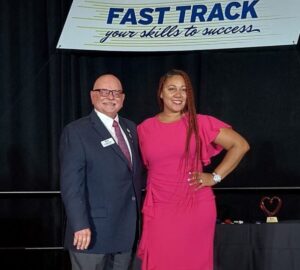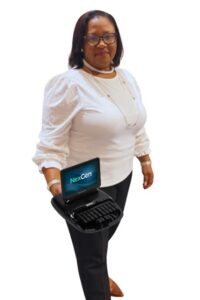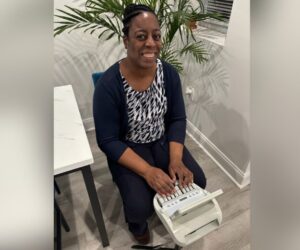
In this interview with Rachel Harris, a scopist currently residing in Lagos, Nigeria, we learn more about the profession of scoping, the ups and downs of her days, and how she makes it all work.
JCR | How did you first find out about and get involved in scoping?
RH | It was through my court reporting teacher that I got to know about and started scoping. That was around 2011.
JCR | What is your day-to-day work like?
RH | So I own a scoping and proofing agency, and I scope on a weekly basis for that agency. I typically work in my office or in my bedroom. I have people I work with regularly. My day-to-day work consists mainly of arbitrations that are immediate. I can scope or proof depending on the day, but I use RealTeam in Case CATalyst most times, and occasionally I work on Connection Magic and Eclipse for dailies. My day also consists of answering questions and reviewing finalized transcripts before they go out to the court reporter.
I had to figure out how to identify how long it took me to scope, which unfortunately I wasn’t able to figure out for a long time.
JCR | What do you like best about your job?
RH | I like the flexibility. I like the fact that we’re in high demand as scopists, so I get to really pick the kinds of clients whom I want to work with. I like being able to consistently learn about new topics. I like a skill that allows me to get better each day, and scoping allows me to do that. I love the fact that the job allows me to be able to travel and support my family and my company.
JCR | What did you find challenging about your work?
RH | The first challenge was deadlines. I had never had a job that had deadlines before. My second challenge was figuring out what court reporters want since no court reporter wants the same exact thing. Overcoming the challenge of deadlines took years for me. I had to figure out how to identify how long it took me to scope, which unfortunately I wasn’t able to figure out for a long time. So I had to tell myself that my deadlines were shorter than they were so I could be on time. But it took me at least two years to be able to meet every deadline that was set before me.
Another way I overcame the challenge of deadlines was realizing that it’s impossible to meet deadlines a hundred percent accurately when you don’t know how difficult the file will be. You need to be able to communicate with your clients as you’re scoping the file so that if things come up that can affect the deadline, you’re not becoming really anxious, keeping information to yourself, and not sharing it with the court reporter. Because, at the end of the day, the quality of the transcript for most court reporters is more important than the deadline. If I’m going to send out an invoice or a bill for a job that I did, the court reporter or the attorneys that request the transcript are not going to be happy that the deadline was met but the quality was poor.
One of the challenges with deadlines is time zones because a deadline in your time zone is one thing, a deadline in three other time zones is something else entirely. How I overcame that challenge was having clocks with all the time zones on my phone physically — widgets — in the time zone that my clients are in. In my office and wherever I’m at I have to be aware of the fact that my clients are in a different time zone and know what time it is. That was another huge challenge.
As far as figuring out what court reporters want, that second challenge, I solved that by asking court reporters to give me previous jobs that were scoped by either themselves or a previous scopist and that transcript tells me 80-90 percent of what I need to know without needing to barrage the court reporter with questions or have a phone conversation, which is not always possible, even though it’s ideal. I learned a lot from studying court reporters’ previous transcripts to tell me what they need (their preference). That helped me to identify that, in fact, no court reporter wants the same thing. So instead of me changing my skills to match one court reporter, I need to have enough skills to adapt to what that court reporter or what any court reporter would want.
I wish people knew that a scopist, in a lot of instances, is as talented as a court reporter.
JCR | Do you work with people who are fairly local to you?
RH | All of my clients are far away from me as I’m currently on assignment in Lagos, Nigeria. But even when I am stateside, my clients are still very far from me. Most of my clients are on the west coast or in the Central Time Zone. Ninety percent of my clients do not share the same time zone as me.
JCR | If you have clients in other countries, do you have to pay attention to differing requirements, or is that something that you expect your client to know?
RH | No, that is not my client’s job to know that the country that I am in is different from theirs. [It is] my responsibility to know the different formats, different spellings, and different punctuation that is local to their area. So, whether that is a preference or a style that is used in the Middle East or punctuation and grammar that is different in Europe, it’s my job to know that.
JCR | Has anything unusual or funny or unexpected happened to you on the job?
RH | Yes, this is the funny one. The story is that there was a lawyer who was very angry. He was known to be rude during the proceedings, so much so that a nun accompanied him for behavior purposes. He did, in fact, behave well in her presence. That was a funny one.
Unexpected. Okay, I can say this. It’s always unexpected when a judge speaks up for the court reporter, and it makes my day. A lawyer prided herself on speaking incredibly fast and warned the court that she’s been known to burn through two court reporters in a day. The judge unexpectedly told her that she was not going to burn through two court reporters that day. If she didn’t slow down, she would be held in contempt and go to his chambers. She wasn’t really taking the judge seriously, though. But as the proceedings got going, she was talking fast, really fast. He kept telling her, “Slow down, slow down, slow down.” The final warning that he gave her literally made her cry. So, he was like, “If you speak quickly again, we will adjourn the proceedings and make you go to my chambers.” She started crying, and she slowed down.
JCR | What do you wish other people knew about scoping?
RH | I wish people knew that a scopist, in a lot of instances, is as talented as a court reporter.
I would definitely recommend scoping as a job, because in this new world of AI, and the ongoing discussions around AI, digital, and stenography, scopists actually have the skills and the intelligence at the intersection of all three. They also have a future career when it comes to court reporting and when it comes to preserving the record because of our extensive knowledge. Scoping is one of the only career paths in this industry that easily gives you access to enough knowledge to do anything you want in this industry.
As a scopist, I’ve traveled the world. As a scopist, I’ve become a trainer, a judiciary trainer, a public speaker, and an entrepreneur. It’s a career path that, if a person applies themselves, costs less to learn than becoming a court reporter, but can have some of the same rewards and some of the same income limits. I know a scopist who easily makes six figures. And, yeah, I’d recommend it.
JCR | If you were able to teach people anything about scoping, what would it be?
RH | If I were to teach people anything about scoping, it would be to gain confidence in understanding rules you don’t agree with. If there’s a rule or preference that a court reporter wants or needs you to follow and you don’t agree with it, you need to understand scoping, punctuation, and grammar enough to know how to apply a rule you don’t agree with. That takes humility, some wisdom, and caring about understanding punctuation, grammar, and software so deeply that you know how to break any rule that there is. If you can figure out how to do that, you will be a booked and busy scopist.
Rachel Harris is a scopist in Lagos, Nigeria. She can be reached at rachel@sopherimandassociates.com.
This interview was originally published in the Journal of Court Reporting.