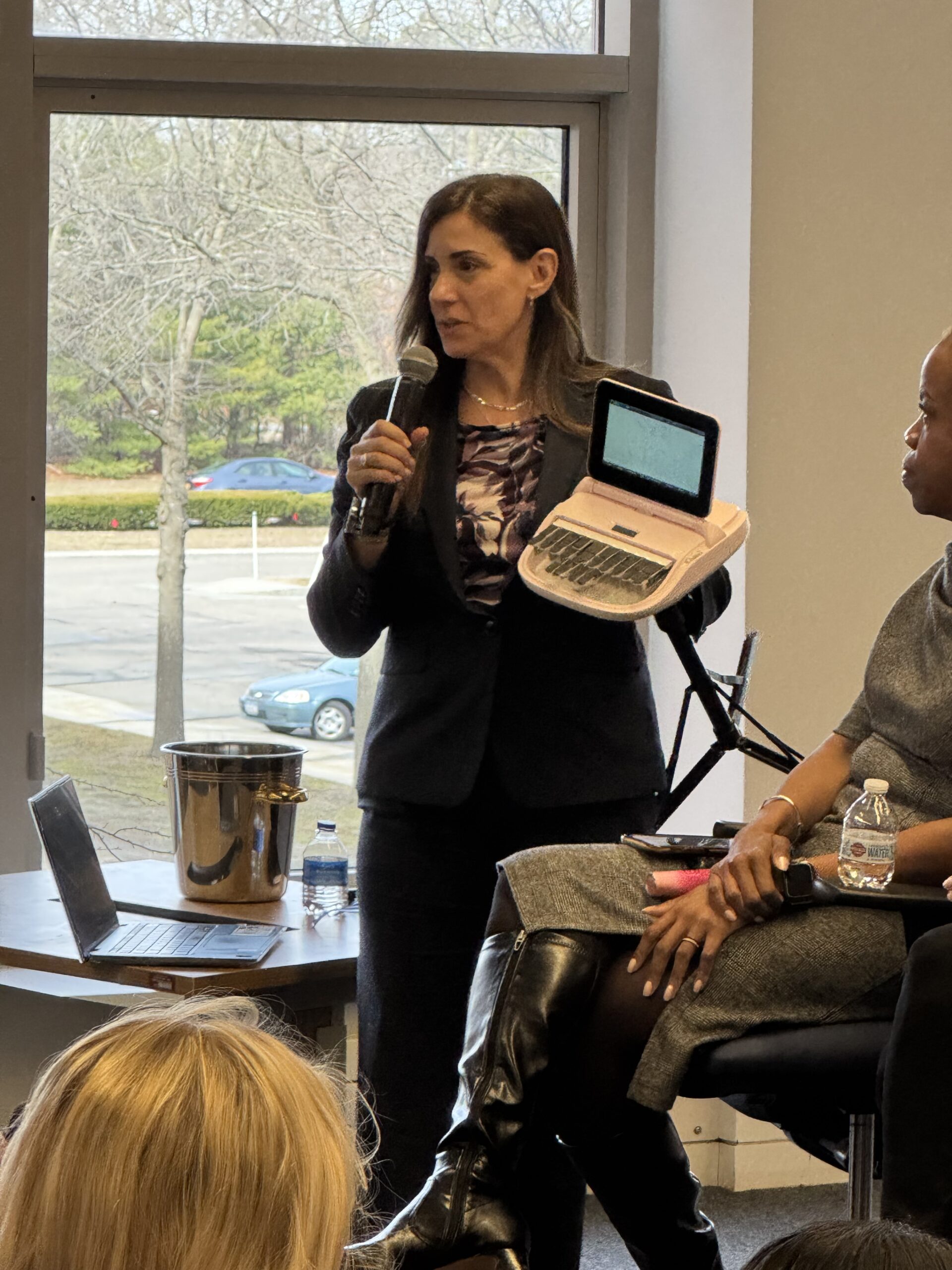
Darlene M. Devlin serves as Co-Chair of the National Court Reporters Association Political Action Committee (NCRA PAC). She has written about her experiences and been highlighted as a court reporting advocate during the Association’s Hill Days and various events in theJCR.com.
JCR | What motivated you to participate in the Women in Law panel during Women’s History Month?
Darlene M. Devlin | Women’s History Month is a time when the Suffolk County District [N.Y.] Administrative Judge’s Office, led by DAJ Andrew Crecca, and the Suffolk County Women’s Bar Association (SCWBA) come together to highlight women’s leadership across the courts. This year, they organized a full month of programs celebrating the many roles women play in the justice system. Being invited to participate in the very first event of the month — the Women in Law panel — was an honor. I felt a responsibility to represent a profession that is often overlooked but absolutely essential to the courts. Court reporting has given me a meaningful, empowering career, and I wanted young women to see that this path exists for them too. Participating in a program hosted by DAJ Andrew Crecca and his office, together with SCWBA, alongside so many accomplished women, made the experience even more special.
JCR | Can you describe the experience of speaking to more than 100 high school students about careers in the legal field?
DMD | It was energizing. Standing in the Central Jury Room, looking out at more than 100 young women — plus many more watching via livestream — you could feel their curiosity from the moment the program began. They were engaged, attentive, and genuinely interested in learning about the many different roles within the courts.
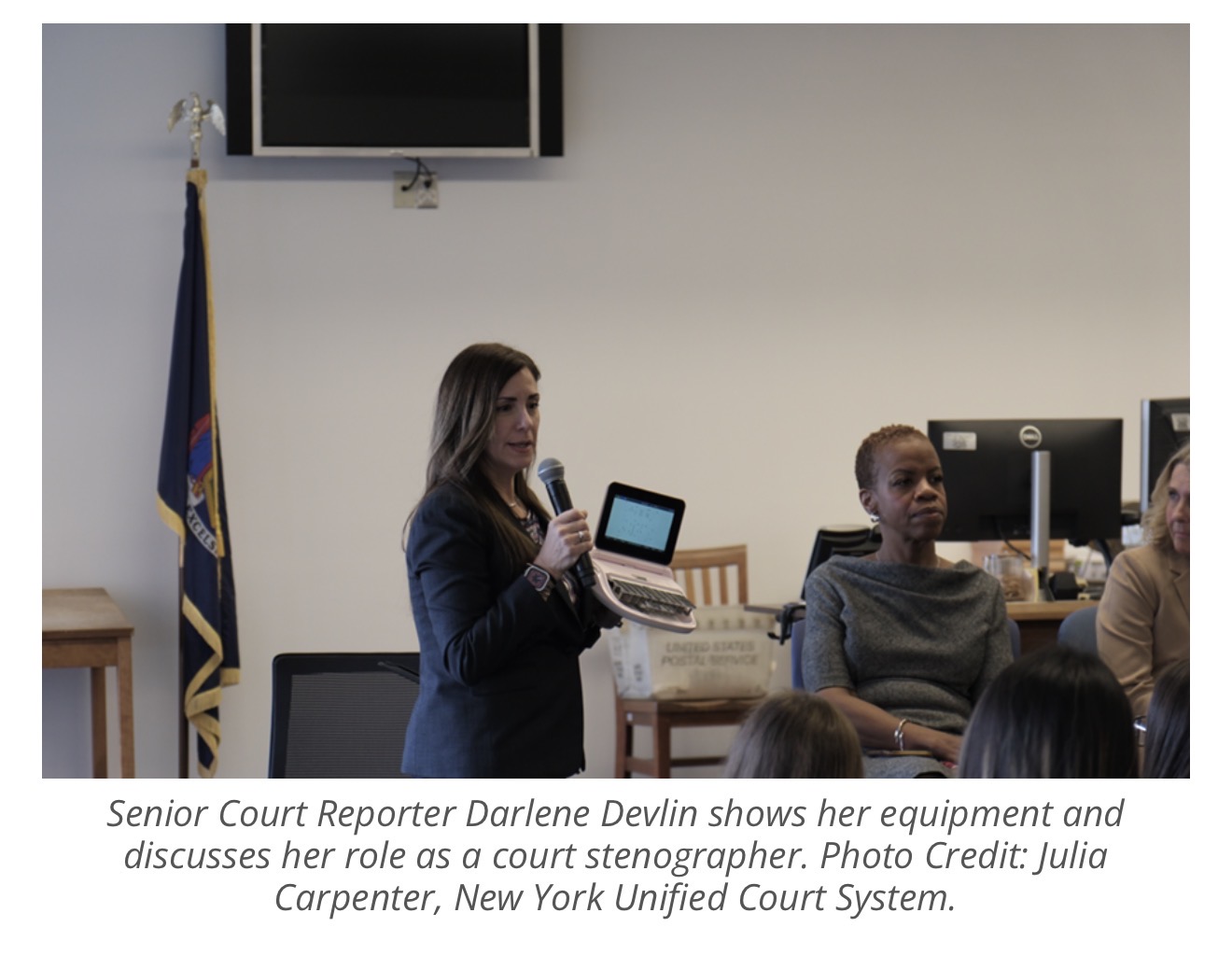
It was also a privilege to sit alongside such an accomplished group of women:
- Hon. Cheryl Joseph, Acting Supreme Court Justice & Supervising Judge of Matrimonial Parts
- Hon. Mary Kate Mullen, Suffolk County District Court Judge
- Julie Walsh, Court Attorney Referee
- Rachel Landkammer, Deputy Chief Clerk
- Sergeant Evelyn Portes, Supervising Court Officer
- Kelli Houlihan, Judicial Secretary
- Shawn Renée Guzman, Principal Court Interpreter
And the discussion was guided beautifully by Renee Pardo, Esq., SCWBA president, who moderated with warmth and insight.
Being part of a panel that represented so many facets of the justice system — judges, administrators, interpreters, uniformed officers, and myself as a Senior Court Reporter — created a powerful message for the students: there is no single path to public service. The students asked thoughtful, mature questions, and you could see the moment when certain ideas clicked for them. It was one of those rare experiences where you feel the impact in real time.
JCR | Why is it especially important to highlight court reporting and stenography to young women?
DMD | Court reporting has historically been a profession where women excel, and it offers something rare: a career that is intellectually challenging, financially stable, and deeply respected. Many young women are searching for careers that allow them to be both independent and impactful. Stenography does exactly that. But because it’s not widely taught or advertised, students often don’t discover it until later in life — if at all. Introducing it early helps broaden their sense of what’s possible.
JCR | How did you approach explaining the role of a court reporter and the importance of creating a verbatim record?
DMD | I brought my equipment and demonstrated how realtime stenography works. Students are always fascinated when they see how quickly we write and how the words appear instantly on the screen. From there, I explained that the verbatim record is the foundation of justice — it’s what ensures fairness, accuracy, and accountability. I emphasized that live stenographers are essential in the courtroom because we capture nuance, clarity, and context in a way no AI system can replicate.
Court reporting has historically been a profession where women excel, and it offers something rare: a career that is intellectually challenging, financially stable, and deeply respected.
JCR | What reactions or questions from students stood out to you the most?
DMD | The students’ genuine curiosity was the best part of the entire experience. They were immediately drawn to the equipment — most of them had never seen a steno machine before — and their eyes lit up when I explained that we write in a phonetic language rather than typing letter by letter. When I demonstrated how quickly the words appear on the screen, you could feel the room shift.
One moment that really stood out was when I read back Justice Cheryl Joseph’s remarks to them. Hearing their own program reflected back in real time made the process feel real and impressive to them. You could see the recognition on their faces: Oh, this is what a court reporter actually does.
They were also amazed when Judge Joseph asked me how fast a court reporter can write, and I told them that court reporters write 225 words per minute. That opened the door to deeper questions about training, accuracy, and what it takes to reach that level of skill. Their reactions showed me that once students understand the complexity and artistry of stenography, they gain a whole new respect for the profession.
JCR | You mentioned “planting steno seeds.” What does that mean to you in terms of the future of the profession?
DMD | Planting steno seeds means sparking interest early — even if they don’t bloom until years later. Many of us discovered stenography by accident. If we can introduce the profession to students while they’re still forming ideas about their futures, we can help build the next generation of court reporters. Every demonstration, every conversation, every moment of visibility is a seed that may grow into a future stenographer.
JCR | How do events like this help address awareness and recruitment challenges in court reporting?
DMD | Awareness is our biggest hurdle. Students can’t pursue a career they’ve never heard of. Events like this put stenography on the map. They allow us to show the technology, explain the training, and highlight the real‑world impact of our work. When students see a live demonstration and hear from someone actively working in the courts, the profession becomes tangible and exciting rather than abstract.
JCR | What role do mentorship and visibility play in encouraging the next generation to enter the field?
DMD | Visibility shows students that they belong in these spaces. Mentorship gives them the support to get there. When young women see someone who looks like them succeeding in a specialized profession, it breaks down barriers. And when they have someone to guide them — even informally — it increases their confidence and their likelihood of pursuing the field. Mentorship is how we sustain the profession, one student at a time.
JCR | How does your involvement in initiatives like this connect to your work with NCRA PAC?
DMD | My work with NCRA PAC is rooted in advocacy — protecting the profession, promoting high standards, and ensuring that stenographers remain essential to the justice system. Outreach events like this complement that mission. Legislative advocacy strengthens the profession from the top down; educational outreach strengthens it from the ground up. Both are necessary if we want a strong, sustainable future for court reporting.
JCR | Why is it important for leaders in the profession, especially women, to take part in outreach during Women’s History Month?
DMD | Women’s History Month is about visibility, empowerment, and honoring the women who opened doors for us. When women in the legal field step forward to share their stories, it shows young people what leadership looks like. It also reinforces that the justice system is stronger when women’s voices, experiences, and expertise are represented. Outreach during this month isn’t just symbolic — it’s a continuation of the work that generations of women before us started.
Darlene M. Devlin is an official court reporter from Patchogue, N.Y. She can be reached at supreme.stenographer@gmail.com.




Comments are closed.