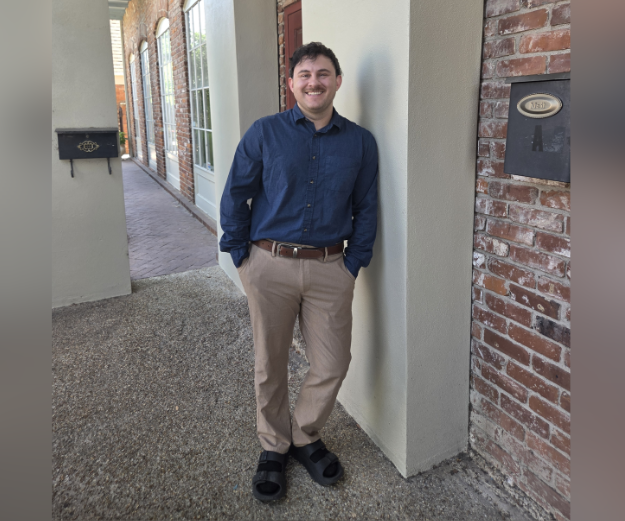
While millions tuned into the 2022 Johnny Depp-Amber Heard trial for Hollywood drama, Hunter Weeks of Vicksburg, Miss., saw something else: the possibility for a new career. Fascination with how the court system brings order to human conflict led him from the trial into the NCRA A to Z® Intro to Steno Machine Shorthand program and eventually to a court reporting track at Pearl River Community College in Poplarville, Miss.
Despite a mid-program theory change, the English major is working toward the goal of becoming an official reporter and maybe one day even writing a stream of consciousness novel entirely on a steno machine.
The JCR Weekly caught up with Weeks to talk about what inspired him to pursue court reporting, overcoming academic hurdles, and why he believes stenography is a skill well within anyone’s reach.
JCR | Can you tell us about your experience in NCRA’s A to Z Intro to Steno Machine Shorthand program? What did you find most informative or helpful, and how did the program prepare you for court reporting school?
Hunter Weeks | The program definitely gave me a good introduction to steno theory. I was able to see right away that I was interested enough to pursue court reporting further. I found the pacing to be stress-free and accessible for a beginner like me. It gave me a headstart that benefitted me at the beginning of reporting school.
JCR | What has your court reporting education experience been like so far? What has been the biggest challenge you’ve faced, and what has been your favorite part of the journey?
HW | It’s been a mixed bag. I love learning steno, but there have been some significant speed bumps in the journey. My class at Pearl River Community College started learning Magnum Steno, but our main instructor left suddenly and our other instructors were unfamiliar with Magnum, so they restarted us learning StenEd instead. We were a year in at this point, so that set many of us behind, and a lot of people got discouraged and quit, unfortunately.
While I made it through the two-year program, I’m now working independently to achieve the speed and accuracy needed to pass the certification test. My favorite part of the journey has been learning this new skill that lets me look at language in a different way. I’ve always been intrigued by language and how it helps us record and communicate. I keep thinking I may write a novel someday completely on steno, just writing stream of consciousness too fast to second-guess myself and see how it turns out.
JCR | You’ve mentioned that binge-watching the Depp-Heard trial sparked your interest in court reporting. What was it about that trial that captured your attention and ultimately led you to explore the profession? Now that you’re in court reporting school, do you view courtroom proceedings differently than you did as a viewer?
HW | Great question. It was partly the drama of it all but even more so, the way all those emotions and personal history and grievances were being channeled through this process of order known as the court system. It made me want to be a part of it.
During that time I got a job as a Deputy Clerk for Chancery Court here in Vicksburg. I swore in witnesses and listened to the proceedings. One of the court reporters there, Ashley Hagg, and I started talking a lot about her job and what it took to be a court reporter. That’s when I started seriously considering pursuing it.
As far as school changing my view of courtroom proceedings, it definitely helped me realize even more how important the role of a court reporter is in the process, how they ground everything in this indelible record that could make or break a case. It’s an honor, really, to be a part of it.
JCR | What are your plans after completing court reporting school? Are there specific areas of the profession you’re most interested in pursuing?
HW | I really want to be an official court reporter. I’m open to different courts, I suppose. At 33 with an English degree and not much interest in teaching, I’ve had a lot of part-time and freelance jobs. Those experiences have been rewarding in their own ways, but I’m ready for something more steady with some health benefits to rely on.
JCR | Speaking of your English degree and your interest in language and phonetics, how has that background helped you as you’ve learned stenography?
HW | It’s been helpful by keeping me interested. Court can be boring sometimes, but language never is. There’s always something interesting about the words people choose or how they correct themselves. It’s fascinating to me. Having a firm foundation of grammar has also been very helpful, although I have to fight my editing instincts at times and just record the sentences exactly as they are spoken.
JCR | You’ve also said you wished you had discovered court reporting earlier. What do you think more students and young adults should know about the profession that they may not realize today?
HW | I always say: Everything is doable. So much opportunity is missed because people lack confidence to try. This path isn’t easy, because it takes a lot of self-motivation, but it can be done, and it seems to be a job that’s in high demand, which is encouraging.
JCR | What would you say to someone who is considering the NCRA A to Z program or court reporting school but isn’t sure whether it’s the right fit for them?
HW | Uncertainty is okay, because this program will help you decide if this is a good fit or not. Remember that it’s just an intro; the theory does get harder and some of it feels counter-intuitive until you practice it enough. And you can always adjust some of it to fit your preferences, but it’s hard to judge that early on. I say: What have you got to lose?
Even if you change your mind, it’s still a good experience. Think of it as a workshop for a hobby that may be fun for a few weeks or may become a permanent part of your life if you love it enough.
Learn more about the NCRA A to Z program
Do you know someone who may be a great fit for a career in stenography? Visit our website to learn about our On-Demand/Asynchronous Online Program, which offers continuous enrollment in the free 45-day program!