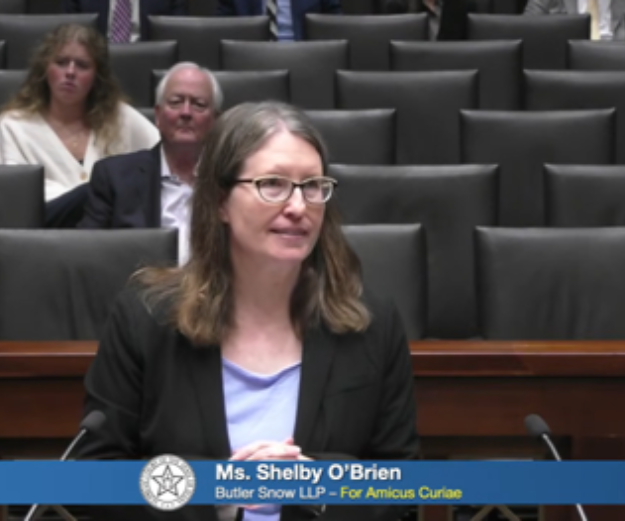
Shelby O’Brien, the Butler Snow LLP attorney who submitted NCRA’s amicus brief in In re Patrick Hughey, urged the Supreme Court of Texas to preserve the statutory protections governing deposition records during oral argument on October 6, 2026. Appearing for the Texas Deposition Reporters Association (TEXDRA), she argued that the procedure used to create the disputed Skribe transcript fell outside current law.
“Current law does not allow what happened here,” O’Brien told the Court.
NCRA’s filing followed coordination with TEXDRA and the Texas Court Reporters Association (TCRA), as the JCR reported in September. The Court’s docket identifies O’Brien as NCRA’s counsel and records her oral appearance for TEXDRA.
O’Brien traced the statutory framework and its exceptions for a party, the party’s attorney, or a full-time employee of either. “There is no exception for a third-party contractor,” she said. She also argued that the 2023 legislation strengthened deposition safeguards, including by removing notaries’ authority to take oral depositions and increasing civil penalties.
Her closing remarks focused on responsibility for the record: “We need regulated accountable human beings behind this,” she said. That emphasis reflects the concerns advanced in NCRA’s amicus brief.
Reddico’s counsel, Stephanie L. Bryant, similarly argued that “the official record has to be maintained by a neutral third party to protect the integrity of these proceedings.” These were positions the advocates held on the disputed law and procedure.
Questions from the bench examined who stands behind a written transcript. During the opening argument, a justice asked where the process would supply “a human being standing behind the transcribed product.”
In rebuttal, Bradley W. Snead, counsel for Hughey, said a human had reviewed the transcription against the video. A justice then raised whether that reviewer needed “some sort of ethical connection to the court system or the courts” so that an inaccurate attestation could have consequences. Snead maintained that “there’s no attestation requirement for written transcriptions.” Those exchanges bring professional accountability and authentication into focus.
As of October 12, 2026, the official docket lists the case as Submitted (Awaiting Opinion). The Court has not issued its ruling.







Comments are closed.