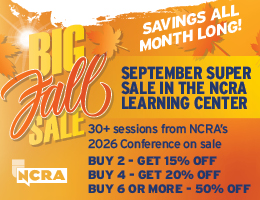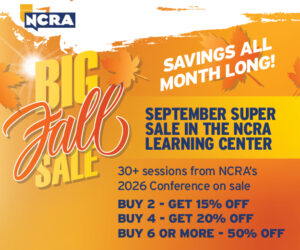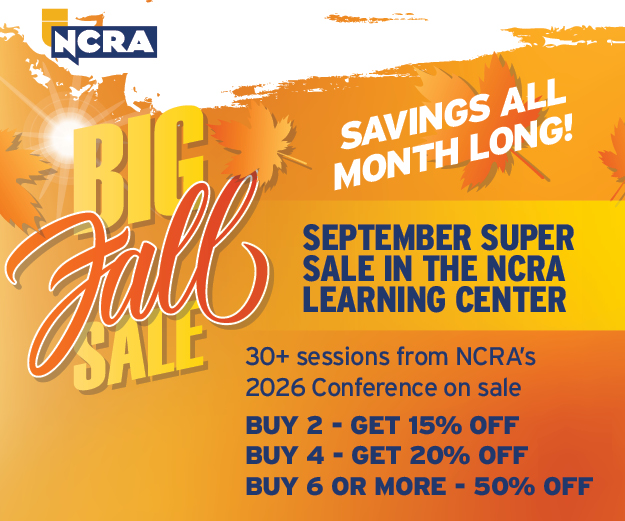
It’s time to see what you missed at this summer’s NCRA Conference & Expo in Bellevue, Wash., and earn some CEUs at a steep discount in the process. Now through Sept. 30, you can save up to 50 percent on sessions recorded at the Conference.
If you weren’t able to join us in the Pacific Northwest this summer, you can now access more than 30 of the most popular sessions covering artificial intelligence, technology, captioning, legal videography, public speaking, and more — all from the comfort of your own space.
Here is the discount breakdown:
- Buy 2-3 Conference session webinars and get 15 percent off
- Buy 4-5 Conference session webinars and get 20 percent off
- Buy 6 or more Conference session webinars and get 50 percent off
To register and purchase webinars, visit the NCRA Learning Center. Conference webinars must be purchased in one transaction to receive the applicable discount. No coupon or code is needed; just add the webinars to your cart, and your savings will be automatically reflected at checkout.
If you previously earned credit for a session at the 2026 NCRA Conference & Expo, you cannot earn it again for the same session’s recording in the Learning Center.
The complete catalog of Conference webinars can be found here, but we’ve got a sneak peek below to give you a taste of what’s in store!
Making Connections – People Skills, presented by Marc Greenberg, CRI
People who know Marc Greenberg, CRI, may say he’s a lot of things: creator of the documentary For the Record, founder of SimplySteno Court Reporting Program, speedbuilding expert, all around nice guy. But extrovert? Even he might not claim that title.
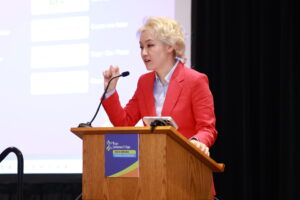
But Greenberg had some tips, and a lot of personal experience, to share with attendees when he gave his session, Making Connections – People Skills, at the NCRA Conference & Expo this summer. A self-proclaimed introvert, he set out to intentionally boost his social skills – not just in his personal life – in a field in which court reporters might mistakenly think they get to be invisible.
The funny, entertaining session included some surprise guests as well. We won’t spoil the surprise (unless you already know who travels the country with her Grammar Table and who walks the Conference halls in their angel wings)!
The Elite Captioning Panel: A Discussion of Captioning/CART Jobs Generally Available and More, presented by: Anna Cillo; Susie Galvan; Jo Gayle, RPR, CRR, CRC; Kelly Keyes-Linkowski, RPR, CRR, CRC, CRI, CPE; and Jamie (Pellegrino) Hoffman, RPR, CRC
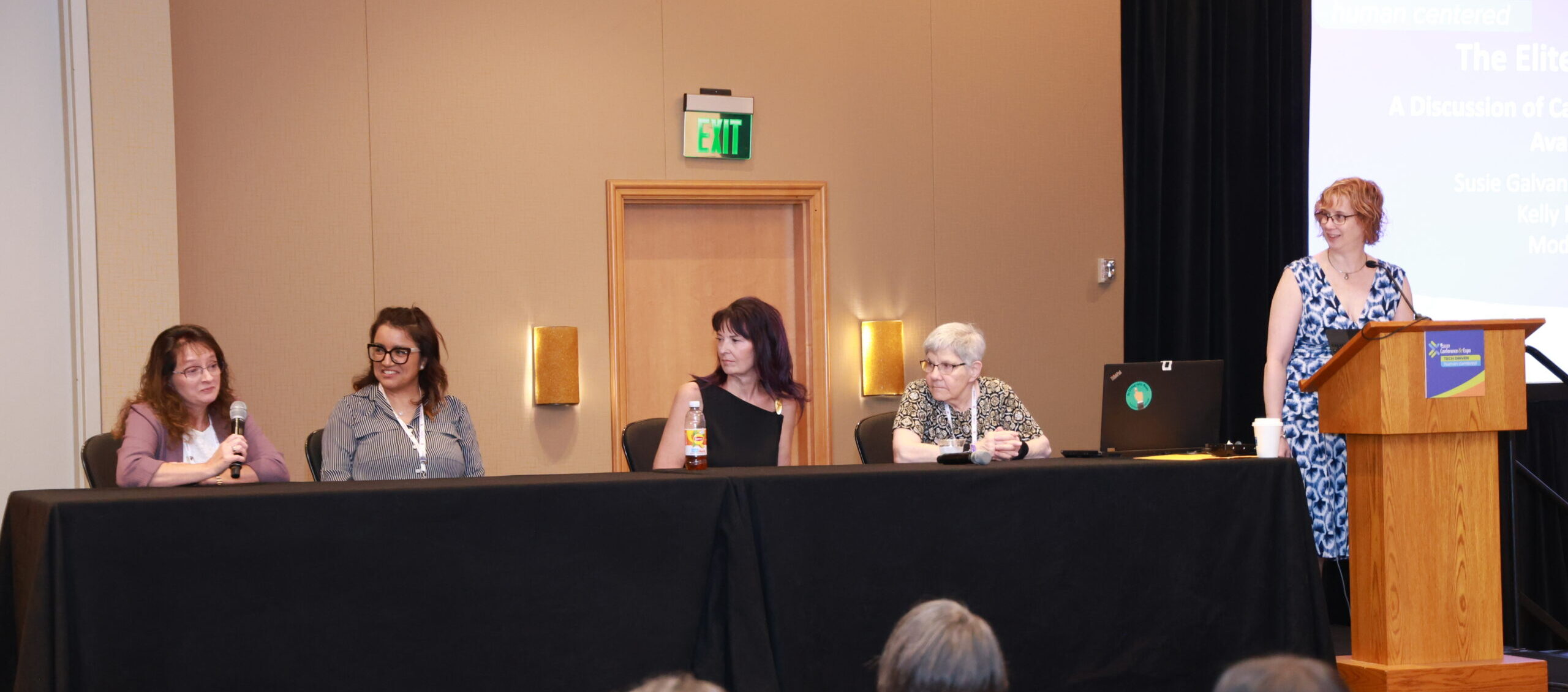
In this session, moderator Anna Cillo, a captioner since 2009, leads a vibrant discussion about the challenges the captioning community faces, the types of captioning jobs available, and the future of the profession. The session also includes a lively question-and-answer section.
The panel features some of the leading professionals in the field, including Jo Gayle, RPR, CRR, CRC, from Chicago, Ill., a 20-year veteran of captioning who was also a court reporter for 46 years; Jamie Hoffman, RPR, CRC, from Bellville, Ohio, a captioner for 10 years and a court reporter for 25 years; Susie Galvan, from Orange, Calif., a new federal court reporter who recently made the transition from captioning; and Kelly Keyes-Linkowski, RPR, CRR, CRC, CRI, CPE, an NCRA director from Rittman, Ohio, who has been a captioner since 1993.
Whether you’re new to the field or just starting out, this elite captioning panel is sure to offer helpful advice for your success.
Best Practices and Pointers for Depositions, presented by Mary Pierce and Chery Scott, RDR, CRR
You don’t have to reinvent the wheel. This is the message that experienced freelance reporters Mary Pierce and Chery Scott, RDR, CRR, stress in their session, Best Practices and Pointers for Depositions. Pierce and Scott, both past presidents of the Deposition Reporters Association of California (CalDRA), define best practices as “a set of guidelines written to provide the most appropriate, ethical, and professional way to navigate situations that may be encountered in the course of reporting.” If you are following the best practices, they advise, then you are generally following the law.
The guidelines provided in the session grew out of resources initially provided to California reporters but have since been expanded to provide a more uniform standard of behavior for national audiences. Topics include how to interrupt proceedings, going on and off the record, exhibit handling, remote reporting, interpreted depositions, and much, much more.
Sound Advice: Audio Basics for Court Reporters, presented by Jean Kim, RPR
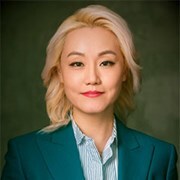
Jean Kim, RPR, freelance court reporter from Los Angeles, Calif., leads this session, which she says is not a software-based session, but rather a primer on audio basics that court reporters would find useful in their own practice. “Let this be a foundation for you to try new features that you’ve been hemming and hawing about,” says Kim.
Covered topics include:
- Why audio matters
- Audio fundamentals: inputs v. outputs
- Where to find Windows 11 sound settings
- Key controls to know
- Equipment list
- Kim’s recording setups (3 scenarios)
- Best practices and tips
- Hardware shopping list
If you’re in need of a foundational understanding of audio capabilities, this is the perfect session for you.
Fast Fingers, Calm Mind: Managing Anxiety in a High-Pressure Profession, presented by Teri Simons, RDR, CRR
Led by NCRA member Teri Simons, RDR, CRR, a freelance court reporter from Bonney Lake, Wash., who is also a practicing therapist specializing in anxiety and OCD, this webinar sheds light on how to identify anxiety, common triggers and causes, and tips for dealing with it.
According to Simons, anxiety occurs when the brain releases adrenaline that puts the body into a fight-or-flight response and can cause dilated pupils, pale or flushed skin, rapid heart and breathing rates, and even trembling. Examples that can cause anxiety for court reporters include test-taking, difficult depositions, and some courtroom situations.
Among the strategies Simons shares to deal with anxiety include reframing thoughts and situations, learning breathing techniques, job preparation, positive affirmations, and potentially seeking professional therapy.
Head over to the NCRA Learning Center today to browse the complete library of recorded #NCRABellevue sessions, build your custom bundle, and claim your savings!
The NCRA Learning Center gives 30 days from the date of purchase to complete all required elements unless otherwise noted.