By Julianna LaBadia
The 55th Intersteno Congress was held in Liverpool, United Kingdom, this year from July 25 to 30. Intersteno is an international gathering of people dedicated to the art and science of capturing the spoken word and preserving the record, held in a different country every other year. The conferences include speakers from around the world presenting data and research on best practices and reporting on their countries’ efforts to ensure an accurate record. (The Philippines is having great success with the NCRA A to Z® Intro to Steno Machine Shorthand program!)
I spoke with Sheryll Holley, a captioner in Wales and the newly sworn-in president of the British Institute of Verbatim Reporters’ board, and Sander Pasveer, the creator behind the magic that brings realtime captions directly onto the presentation screen, Text on Top.
Here is a behind-the-scenes look at captioning the Intersteno conferences.
JL | Sheryll, tell us about your experience at Intersteno Liverpool this year.
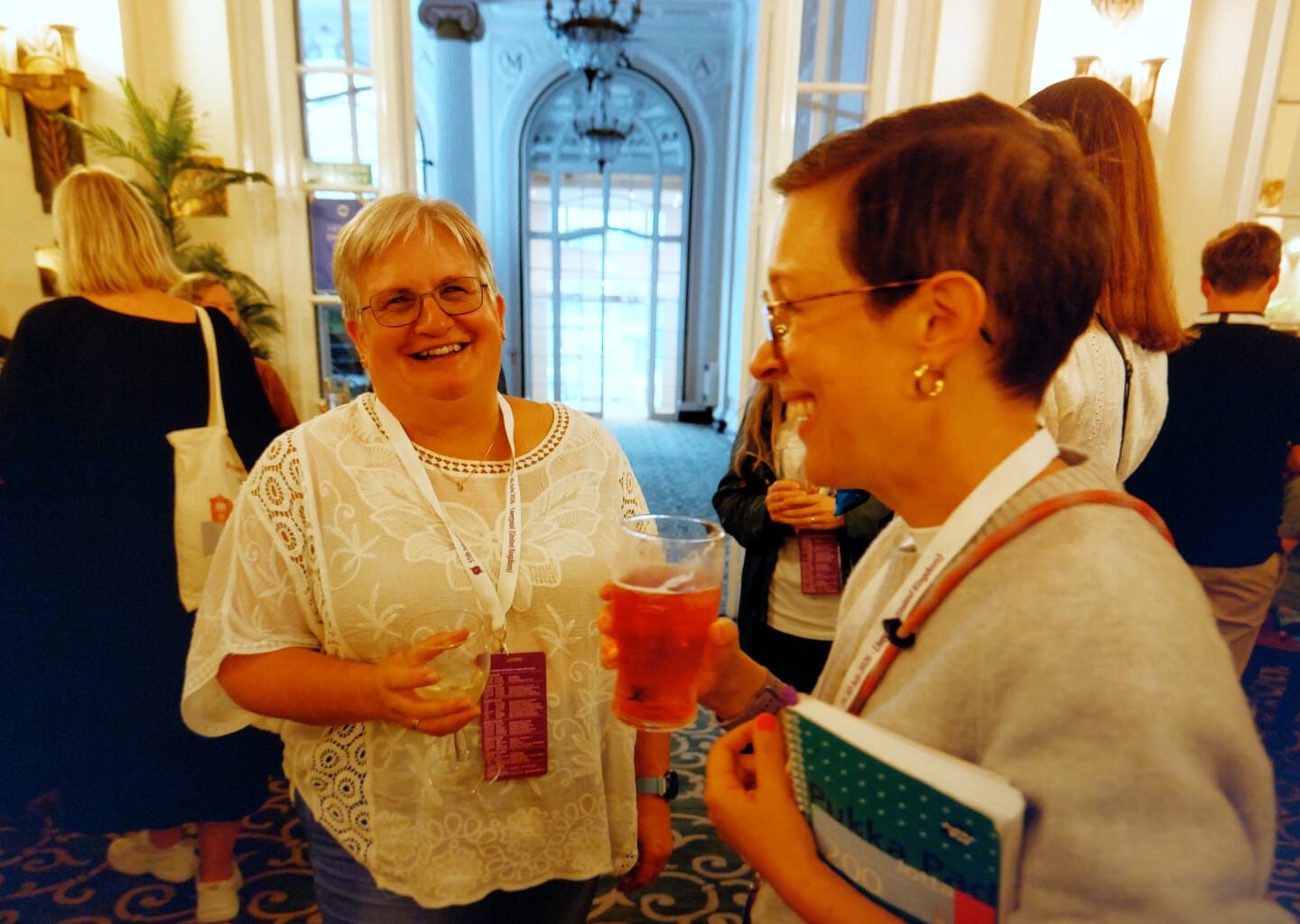
Sheryll Holley | This was my fourth Intersteno! Having experienced my first Intersteno in Cagliari, Sardinia, then Maastricht, Netherlands, and Katowice, Poland, I’m pleased to say the weather was equally as good in Liverpool.
The best thing about attending the Intersteno conference biannually is the people! You get to meet and greet old friends and make new friends:
- the lovely Juli LaBadia, RDR, CRR, CRC, from the United States (now the U.S. Board Member for Intersteno), who we see at every conference — it wouldn’t be the same without her!
- Carlo Eugeni (the mad Italian professor, also Chair of the Scientific Committee), who I regularly talk to and don’t think I’ve ever not laughed with during one of our conversations!
- Mr. Intersteno, Danny Devriendt, who faithfully does a large part of the organizing of the conference every year.
- The lovely Rian Schwarz-van Poppel, who is the President of Intersteno and always a lovely person to meet every time we go.
- Georgette Sante, Jury President, another key character in the Intersteno family.
I also can’t forget my U.K. colleagues, the lovely Georgina Ford, RMR, CRR, and Ian Roberts, who played a major role in organizing the conference this year, as well as Mary Sorene, Secretary and Treasurer of BIVR.
JL | Tell us how you became involved in captioning at Intersteno.
SH | As a captioner, I have been happy to volunteer for the captioning at all the Intersteno conferences. Speakers are always varied, and some memorable moments have been had across the captioning teams. We have had teams of machine writers from the U.K. and U.S. volunteer over the years. This year was no different.
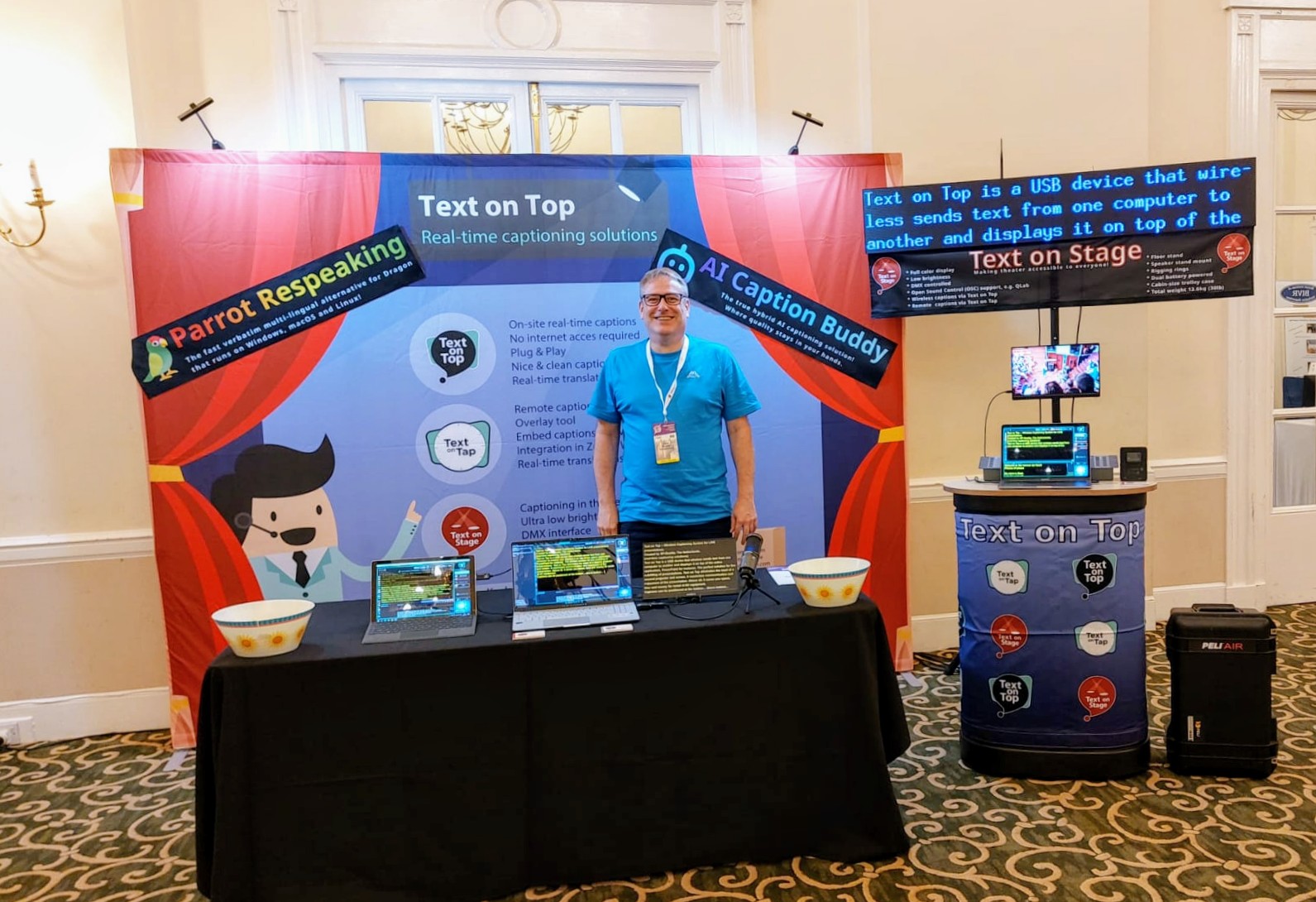
One of our good friends who we’ve met time and time again has a wonderful brain for tech, Sander Pasveer, the creator of Text on Top, whose software is used across Europe and in the U.S. He has continuously updated the software and has since created Text on Tap and Text on Stage. The captioning couldn’t be accomplished so seamlessly at Intersteno without him!
Text on Top enables captions to be shown on top of the presentation. It is also the name of the company.
Text on Tap is the streaming platform for Text on Top, so that a captioner can stream text over the Internet.
Text on Stage is a full-color LED dot matrix screen that shows three lines of text and is used to provide captions in theatrical spaces (even outdoors).
JL | What is Text on Top, and when did you create Text on Top and then later Text on Tap (for internet use)?
Sander Pasveer | Text on Top makes it possible to provide realtime captions on top of any application (usually a PowerPoint) shown on the main screen without complicated and expensive gear. Having captions and the presentation on the same screen saves space, money, and improves the whole experience of an event.
I created Text on Top about 14 years ago after returning from a conference in Helsinki, Finland, about accessibility. Ironically, I was stunned by some of the ways accessibility had been implemented at the conference as well. I kept thinking: There has to be a better way of doing this. I just HAD to invent a solution!
The idea was to make access to professional captioning possible for everyone, from small gatherings to large-scale conferences, without requiring complicated setups.
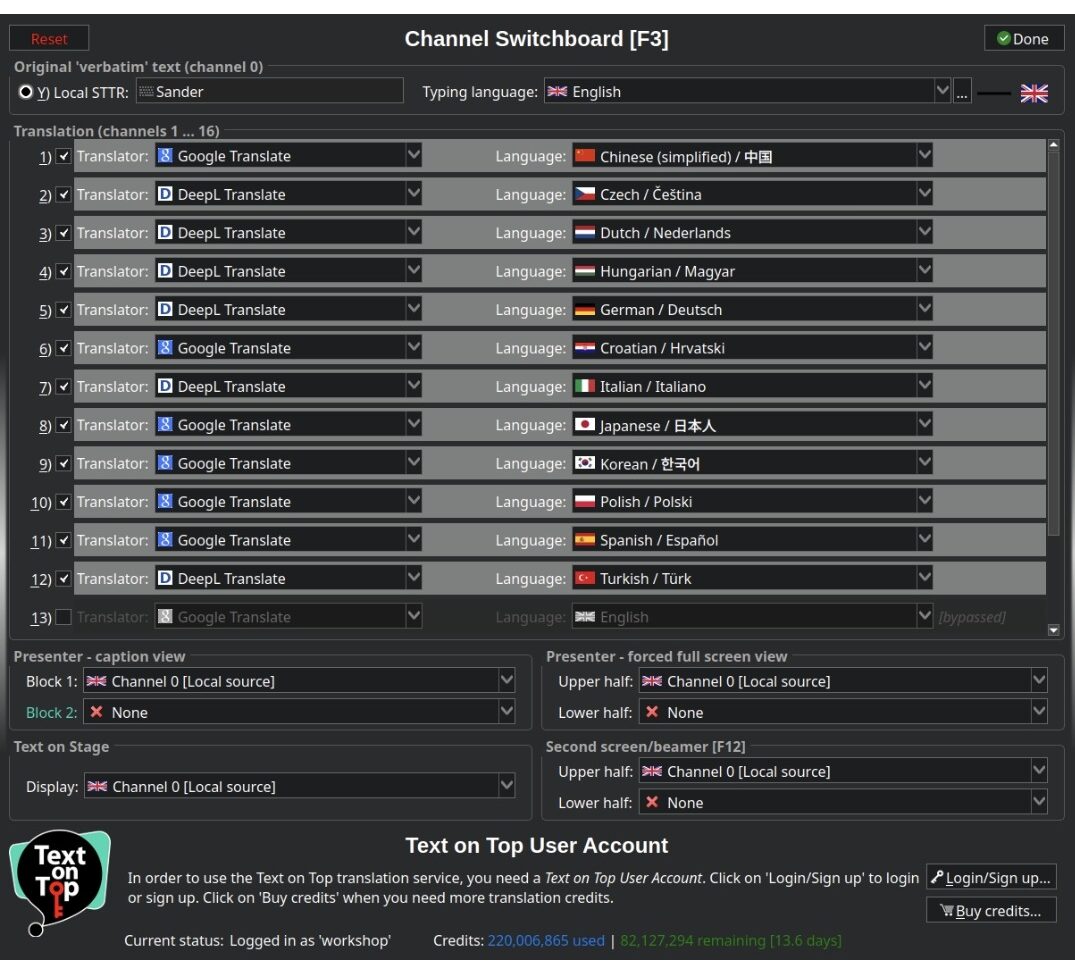
SH | We’ve used Text on Top at every Intersteno that I’ve attended. And during the Intersteno conferences we also provide live translations in many different languages using Text on Top dongles on tablets that Sander hands out or scanning a QR code for Text on Tap. For readers who don’t know, as the captions are fed through, the English can be sent directly to Google after a full stop (period), and Google will then send the translated sentence back in the chosen language.
JL | There is virtually no lag time in the captions coming through. It’s very gratifying that people are reading your captions in their language quickly enough to get a joke and laugh along with everyone else. How did the pandemic in 2020 affect Text on Top, when everyone had to work remotely?
SP | The solution for online/remote captioning had actually already been developed in 2016, but for various reasons it never saw the light of day at that time — until the pandemic in 2020 when suddenly the whole world switched to remote events and meetings.
Thanks to what I had developed in 2016, I was able to launch Text on Tap almost immediately, and basically my whole customer base in Europe embraced it for their remote captioning jobs. The key to that success was that creating and managing “TAP events” is done within the environment captioners already knew and were comfortable with: the Text on Top Reporter software.
It became very clear that remote work was here to stay. So over the years Text on Tap has been enhanced with many new features and tools. One tool I particularly like is the dedicated tool that allows word-by-word(!) realtime captions in Zoom.
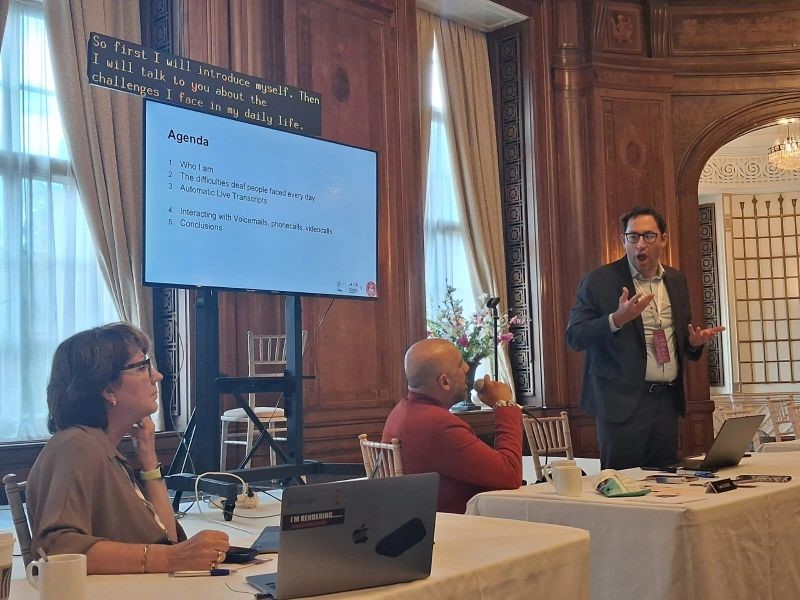
JL | How many languages can Text on Top run at one time?
SP | My initial focus was on people with hearing loss, but in 2014 I added machine translation (using Google and DeepL). That opened up the possibilities enormously, because suddenly events could become accessible to people who didn’t speak the event’s main language as well.
Intersteno is actually a good example. English is the “official” language of Intersteno. However, many attendees do not understand English fluently. At the Diamesic conference, captions were provided simultaneously in more than 10 languages, allowing attendees who otherwise might have been excluded to follow the interesting topics being discussed. Currently the limit is 16 simultaneous translations. But 16 is simply an arbitrary limit; it’s not a fundamental technical limitation.
JL | Your latest project is Text on Stage. Tell us what it’s about.
SH | During the conference, Sander’s new Text on Stage screen was placed where it could be seen alongside the speaker and the main PowerPoint screen. It was great to follow along, especially for those who have a hearing impairment or poor concentration.
SP | Occasionally, people asked me if I had a solution for live captioning in theaters. Of course, a service user cannot simply hold a tablet in the middle of the audience! In September 2018, I decided to do some research. I made a list of requirements and started looking for all kinds of possible solutions, including some less obvious ideas such as laser beams projected onto fluorescent paint.
But it soon became clear that LED technology was the best solution because there is no backlight involved. It is very important for the screen to operate at a very low brightness. You don’t want a screen to destroy the experience of the play!
For this reason, adding DMX was a no-brainer. If you want theaters and actors to accept (and preferably embrace) such a screen, you have to show them that you understand “their world.” DMX gives them full control over the brightness and colors just like any other lighting fixture. So, for example, during a romantic scene the text could turn soft red, while a sudden blackout could also blank the screen to preserve the full dramatic effect.
I assembled my first prototype in December 2018 and demonstrated its successor at Intersteno in Cagliari (in 2019): a two-unit, foldable screen. Text on Stage was born!
But then John Wissenbach, RDR, CRR, CRC, said: “Nice display, Sander, but we need something smaller so we can hop on an airplane.”
Slightly irritated, I drove all the way back to the Netherlands thinking: “How on Earth can I fit a 60-inch screen into a cabin-size case?!” But I did! It took me about six months to design a screen consisting of three units that could be assembled into one large screen. In March 2020, the parts arrived from the factory, and I built four complete systems.
March 2020 … does that ring any bells? Oh, yeah. Bummer: Covid! I had to put the project completely on hold and focus on Text on Tap.
Finally, in January 2025, I found the time to continue working on Text on Stage. The good news was that during the years the project was on hold, many new insights and ideas had come to me, like the idea of making the screen battery-powered. That had a huge impact on the electronics, though. I had to start completely from scratch, and the housing design also needed many changes.
In July 2025, the new electronic boards and housing arrived. Despite some silly design errors, I was very pleased with the result! And then, in June 2026 (that’s only eight weeks ago), the renewed electronic boards arrived, and I managed to show the final Text on Stage at Intersteno in Liverpool.
JL | When do you anticipate it being ready for users to buy?
SP | I still need to work on some final details, and then I’ll start manufacturing a first small series. The size of that first batch will depend partly on the response from the market. I hope this is feasible this year!
JL | Thank you both for taking the time to answer questions. Sheryll, is there any other part of the Intersteno experience this year that you’d like to share?
SH | As myself and my husband, Neil, are from Wales, we were asked by the lovely Krystian Wawrzynek (the board’s newest vice president and organizer of the Youth Texting Competition) to put together a passage in Welsh! They had to copy type (type exactly the text you’re looking at without error) in the Welsh language, so no one would have a language advantage as no competitor had any knowledge of the Welsh language. For your amusement, the translation is below. Thanks to Neil (Holley) for putting this together – his Welsh is better than mine!
“Dw i eisiau mynd i Llanfairpwllgwyngyllgogerychwyrndrobwllllantysiliogogogoch yn yr haf. Wyt ti eisiau dod gyda fi eleni? Gallwn ni aros yn y gwesty wrth yr orsaf.”
Translation: I enjoy going to “St Mary’s Church in the Hollow of the White Hazel near a Rapid Whirlpool and the Church of St. Tysilio near the Red Cave” in the Summer. Would you like to come with me this year? We could stay at the hotel near the station.
Yes, Llanfairpwllgwyngyllgogerychwyrndrobwllllantysiliogogogoch is a real place in Wales!
We were pleased to hear that the winner got every letter perfectly!
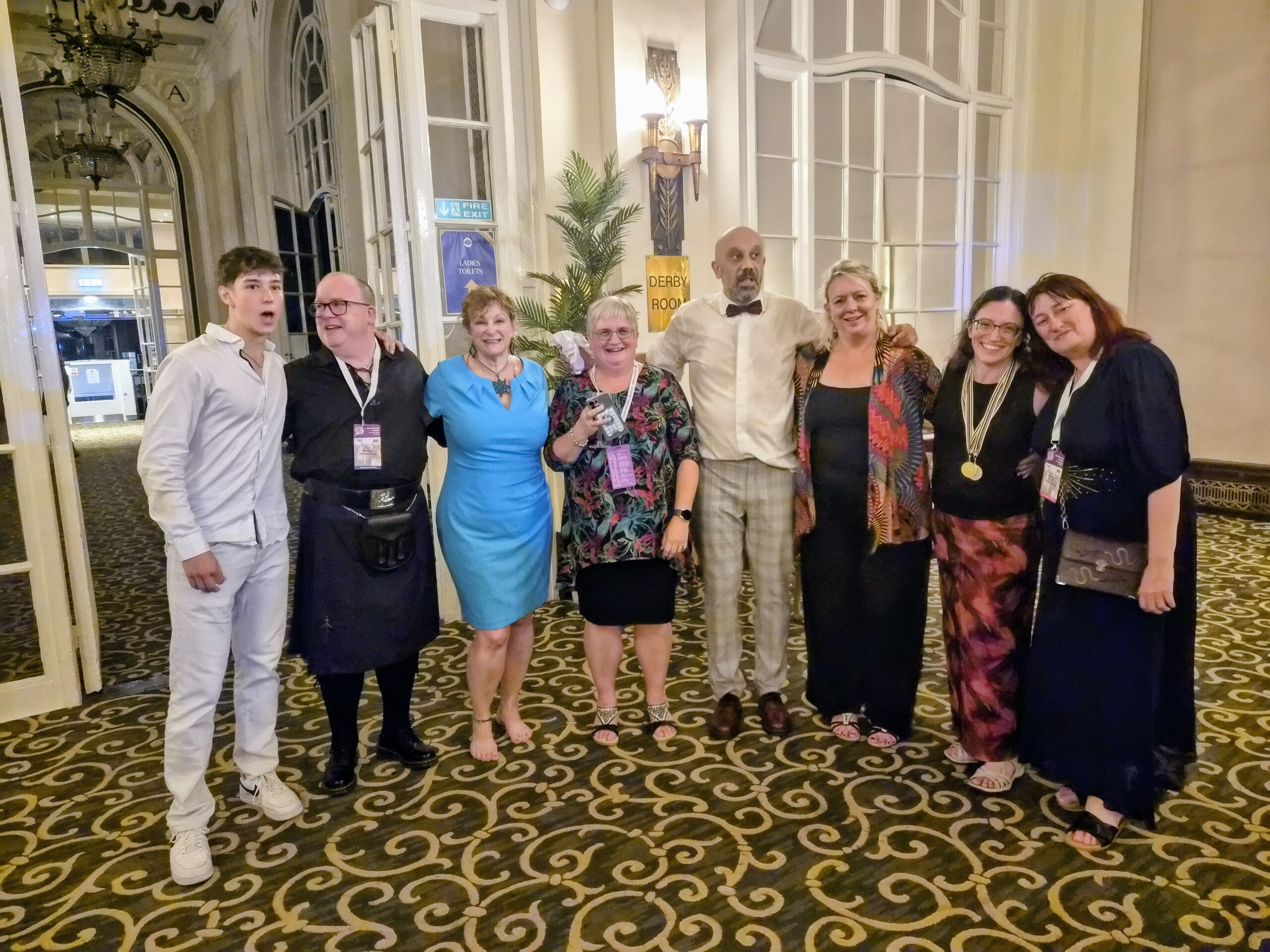
There were lots of great moments from this conference, and I very much look forward to attending the next one in Europe in two years’ time!
Julianne LaBadia, RDR, CRR, CRC, is an official court reporter based in Wilmington, Del. LaBadia is also a member of the Intersteno Board. She extends her thanks to Russell Page, who has stepped down from his position as Vice President on the Intersteno Board this year, and thanks him for his service for the past few years on behalf of both Intersteno and NCRA members. She can be reached at Juli.LaBadia@delaware.gov.